
By Mike Cohen
Native Montrealer Judy Batalion, the critically acclaimed author of several non-fiction books, most recently the New York Times bestseller The Light of Days, has published a powerful debut novel called The Last Woman of Warsaw. While writing The Light of Days, the story of Jewish women who fought the Nazis from the ghettos in Poland, Batalion became obsessed with the cosmopolitan society that had created these extraordinary young women. Her novel shines a light on the rarely explored world of inter-war Warsaw, a city filled with theaters, cabaret, and nightclubs with revolving dance floors. It follows two very different Jewish women in the vibrant, stylish city (the “Paris of the North”) in the late 1930s, as they unexpectedly come together in their search for love, meaning, and a sense of home—while grappling with the storm clouds gathering around them.
Batalion grew up in Montreal. She studied the history of science at Harvard before moving to London, where she did a PhD at the Courtauld Institute of Art and worked as a curator by day and a comedian by night. She is now an author and essayist, and lives with her husband and daughters in New York City. Her brother is Eli Batalion, one half of the YidLife Crisis comedy duo,.
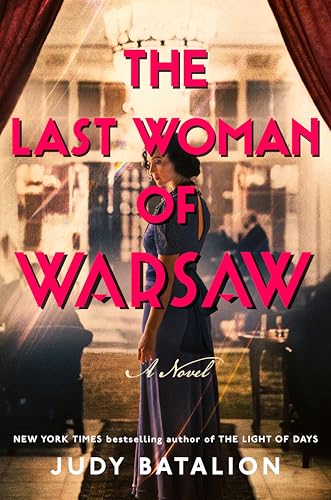
This book is real page turner, cleverly switching each chapter between the man characters Zosia and Fanny.
Fanny Zelshinsky is a sophisticated daughter of the city’s Jewish elite who wants nothing more than to be recognized as a legitimate artist by her family, her radical professor whom she idolizes, and the world at large. She is engaged to a decent man, but she fears marriage will stymie her artistic pursuits and debates whether she’ll go through with the wedding. Meanwhile, Zosia Dror has left behind her small northeastern shtetl and religious family in the wake of violence. She is part of a budding youth movement that believes in social equality and creating a Jewish homeland, but she must resist the city’s many distractions—the glitz, the hubbub, and the keen eyes of a tall, handsome comrad

The two young women are thrown together when legendary artist Wanda Petrovsky—a member of Zosia’s movement leadership and Fanny’s beloved photography professor—goes missing. As they search for the elusive firebrand, questions arise: is Wanda simply hiding, or is her disappearance connected to the rise in antisemitic laws and university practices? Fanny and Zosia are unlikely allies, but they must bridge their differences to help someone they both care for—and dodge the danger mounting around them in the process.
“While writing The Light of Days, the true story of young Jewish women who fought the Nazis from the ghettos in Poland, I came across countless examples of confident, bright lipstick-wearing Jewish women,” Batalion said. “I became obsessed with 1930s Poland, and especially with Warsaw, an exhilarating locus of cultural florescence that’s been eclipsed by what came after. The Last Woman of Warsaw is in many ways a fictional prequel to The Light of Days and tells the story of an unlikely friendship between two 22 year -old Jewish women, each from a different walk of life, showcasing the diversity of Polish Jewry in a thriving, sophisticated Warsaw in the late 1930s.”
Before Vegas, Batalion notes that Warsaw was the capital of neons! “One-third of the population, including my grandparents, was Jewish, and shared in a golden age of poetry, film, and comedy. Jews were multilingual,” she explained. “ Jewish political parties abounded. There were 180 Jewish newspapers in the capital alone! Moreover, it was a progressive era for women, who gained the vote in 1918. Education was mandatory for girls; women attended university, married late, and worked, comprising nearly half the Jewish labor force. Even their clothes favored comfort and movement. Young Jewish women, some of the first not to be match-made and pursuing love relationships, were learning to make their way in the modern world, fueled by neat haircuts, fitted blazers, and shorter skirts. These women were ready to soar—figuratively, and literally.”
Batalion goes on to say that this was also a time of growing nationalism and antisemitism, both social and institutional. “Riots and boycotts abounded, and anti-ethnic laws were passed; notes of doom seeped in from neighboring Germany,” she said. “ Still, Poland’s Jews went on; they’d spent 10 centuries finding their place in a country where they were “othered,” but also, tolerated, emancipated, and thrived. They had no idea their lives straddled the precipice of hell. This is not the story about how Jews died in Poland, but rather a story about how they lived there. These characters are aware of political conditions that shape their lives, but primarily, they are experimenting with being modern women. They grapple with friendships and romance, with the meaning of art and identity, and with their feelings about their Jewish heritage and their future, all as they try to figure out what lives they want to lead in a future that remains bright. This is a novel about friendship, and how small decisions can have great consequences. We readers understand the cataclysmic context in a way the characters do not. When I first drafted this novel in 2021, I aimed to bring to life “Golden Warsaw,” to resurrect the art world that was annihilated alongside its artists and audiences. In the dark years since, with increasingly rampant extremism, nationalism, terrorism, barbarism, and antisemitism, this exhilarating and terrifying period is only more relevant. It is crucial that we understand what a vibrant and sophisticated place Warsaw was, because only then we can understand that “they” are like “us,” and what happened to their vibrant, sophisticated world can so easily happen to ours.”
 The Jewish Standard Magazine