
Montreal to host celebration as part of global New Year for Animals campaign

Jewish Vegan Life (JVL) in Montreal is reviving and transforming an ancient holiday dedicated to elevating animal protection and stewardship within contemporary Jewish life. The JVL Montreal Tikkun Circle will host a community celebration for the New Year for Animals on Sunday, August 9 ( 12:30 PM) in Mount Royal Park. 
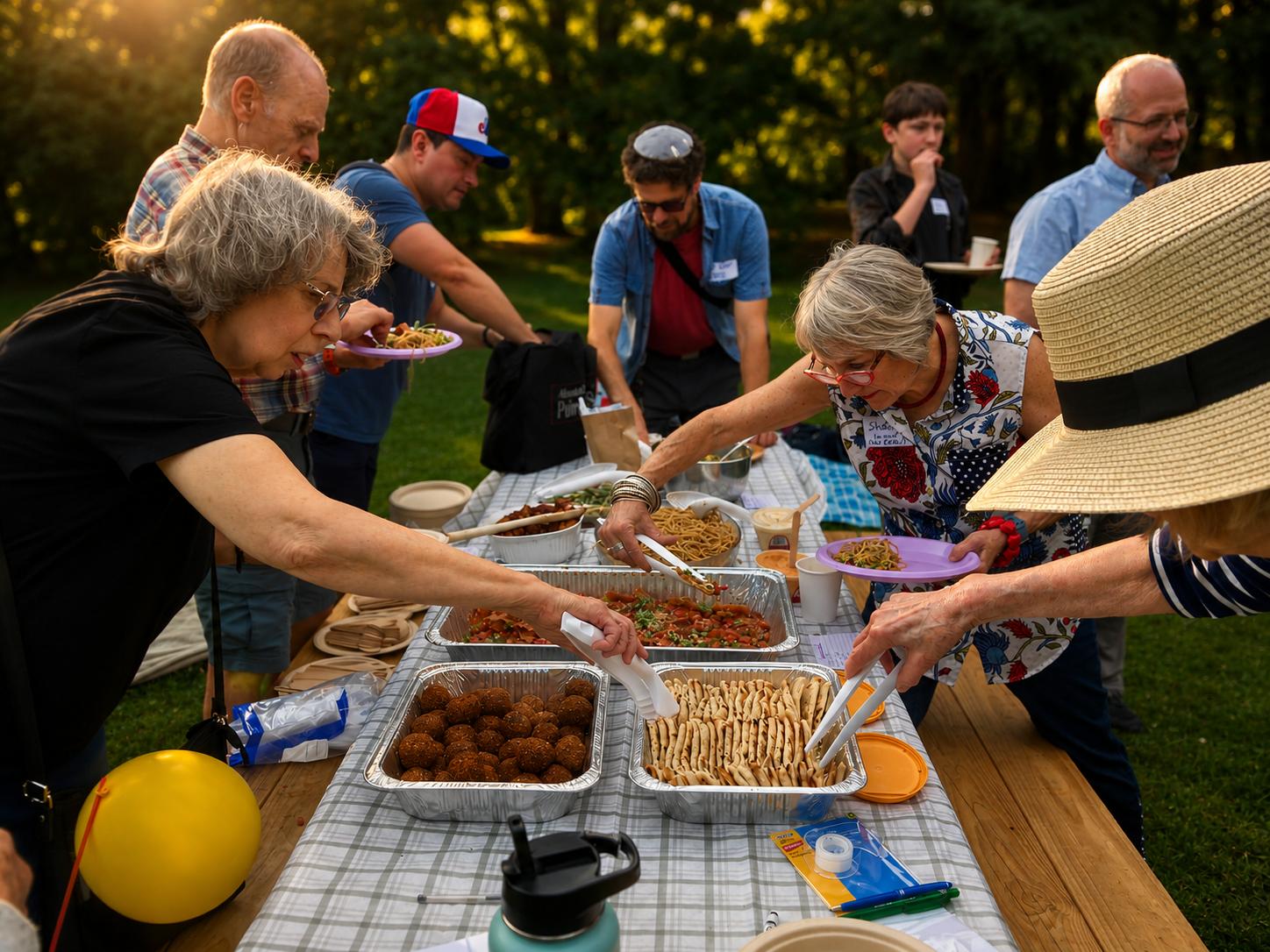
Participants at another recent Jewish Vegan Life event.

The free event features an outdoor vegan picnic, live acoustic community music, and spiritual learning. Rabbi Boris Dolin, rabbi at Congregation Dorshei Emet and spiritual leader of JVL Montreal, will offer reflections on how this ancient tradition addresses modern animal welfare.

The gathering is part of a coordinated global campaign—including multi-city activations in Washington, D.C., Pittsburgh, Los Angeles, Jerusalem, and a major virtual livestream—by JVL to revive the ancient Jewish New Year for Animals, focused on stewardship, gratitude, and compassion for all living creatures.

This hidden holiday appears in the Mishnah, an 1800-year-old text of Jewish traditions, and originally marked an ancient tax deadline for tithing domesticated livestock. The 2026 modern campaign dynamically reimagines the day, shifting the focus away from property or sacrifice and toward mindfulness and active compassion for all living creatures.

“The New Year for Animals is a call to step away from factory farming, aligning our modern food choices with our deepest spiritual values,” said Michael Gribov, Head of Movement Building for Jewish Vegan Life. “Gathering over a shared meal right before the High Holidays gives our local community a unique space to turn powerful values into everyday actions.”

What to Expect

  • Expert Insights: Spiritual reflections from Rabbi Boris Dolin.
  • Community Picnic: A relaxed plant-based potluck where attendees are invited to bring a vegan dish or order local vegan pizza.
  • Live Music: Informal acoustic music and community singing, with guests encouraged to bring their own instruments.
  • Inclusive Space: The event welcomes individuals of all faiths, backgrounds, and dietary paths. Pets are also welcome!

A Connected Global Movement

The Montreal celebration serves as a vital anchor within a cross-continental footprint, aligning local community actions with international advocacy:

  • August 9 – Global Livestream Celebration (Virtual Anchor Event): A worldwide broadcast featuring leading voices from Mercy For Animals, The Good Food Institute, and Freedom Farm Israel.
  • August 9 – Washington, D.C. Community Dinner: The DC Tikkun Circle plant-based gathering focusing on sustainability and Jewish wisdom.
  • August 9 – Montreal Community Circle: A community picnic with Rabbi Boris Dolin.
  • August 13 – Los Angeles Celebration Seder: An interactive West Hollywood dinner experience led by Rabbi Jonathan Bernhard.
  • August 13 – Pittsburgh Seder of Compassion: A guided community seder at Beit Kulanu featuring a gourmet plant-based dinner.
  • August 13 – Jerusalem Vegan Potluck: A local gathering in Israel exploring Jewish teachings on stewardship.

Bringing Action to Core Jewish Values

The Montreal gathering requires no prior knowledge of Judaism or veganism and is open to anyone looking for a welcoming community. Attendees will enjoy thoughtful conversation, delicious plant-based food, and deep reflections on the traditional Torah commandment of Tsa’ar Ba’alei Chaim (the prohibition against causing unnecessary animal suffering). 

“There is special value in identifying a day in the year for particular attention to our obligations towards animal life. Thousands of years before societies for the prevention of cruelty to animals were even thought of, the Torah introduced legislation in this regard, emphasizing our responsibilities to be caring and compassionate towards all sentient beings. These teachings are not adequately observed today, and it is most important to raise such awareness accordingly,” said Rabbi David Rosen, member of the JVL Executive Council.

“The Jewish New Year for Animals is one of Judaism’s hidden treasures. At a time when our world is searching for greater compassion and connection, this ancient observance reminds us that our tradition has long recognized our responsibility toward all living beings,” said Raquela Karamson, CEO of Jewish Vegan Life. 

Jewish scholar and educator Dr. Richard H. Schwartz has championed renewed awareness of the New Year for Animals as a meaningful expression of Jewish values.

“For decades, I have advocated that the Jewish New Year for Animals deserves renewed recognition as an expression of Judaism’s profound stewardship of creation to align our choices with the Torah’s commandment of Tsa’ar Ba’alei Chaim. In an era of factory farming and ecological crisis, reviving this holiday is a necessity to heal our world. I am incredibly grateful to see Jewish Vegan Life providing the global infrastructure, community, and joyful spaces needed to turn powerful theological ideals into a living, breathing contemporary movement. By organizing across continents and building coalitions with leading animal protection groups, Jewish Vegan Life is successfully re-anchoring Jewish identity to its core, foundational values of active compassion, environmental stewardship, and absolute reverence for all of God’s creatures,” said Dr. Schwartz.

Registration & Ticket Details

To register or learn more about the campaign, visit: https://JewishVeganLife.org/events/montreal-new-year-for-animals

About Jewish Vegan Life

Jewish Vegan Life Inc. is an international non-profit fostering a healthier, more sustainable, and more compassionate world by connecting Jewish tradition with plant-based living.

Caring for a loved one with Alzheimer’s

By Shirley Muhlstock Brodt

Sentio, Ergo Sum *

(I feel, therefore I am)

I have no words of wisdom to comfort those whose loved one has Alzheimer’s. Of all the diseases, there is none more obscene: It’s the only disease that as it progresses, the person with the disease suffers progressively less and less, and the loved ones suffer more until their suffering becomes almost too great to endure.

Many relatives of the Alzheimer’s patient don’t visit them. It might be just too painful for them to witness the decline of the once-disease-free and functioning person. What I’ve witnessed is these patients sitting and staring at the walls or at staff passing by, but as for hand-holding or hugging or kissing or smiling, these acts of kindness have disappeared along with the patients’ memories.

My 78-year-old sister (let’s call her Rosie) is now in the advanced stages of Alzheimer’s. When she was first admitted on an emergency basis to the long-term care facility seven years ago (her husband was very ill and was hospitalized on an emergency basis), Rosie was able to dress herself, walk quickly through the halls, eat on her own, use the bathroom, talk with me and with those around her, sing and play the piano (she was very gifted musically), and watch and sing along to the hundreds of music videos I had downloaded for her. Of course, she demanded of me that I bring her to her husband, which I did. Seeing her husband calmed her down, and shortly after we returned to her care facility, she pleaded with me to visit her husband (having forgotten that we had returned an hour before). A month after she was admitted, her husband died. Her five children, four of whom lived outside Canada, attended the funeral.

  (A note about destiny. Within an hour of Rosie’s arrival at the facility, her primary nurse’s aide came to introduce herself. Her name was Ann, the same name as that of my dearest younger sister who had died 19 years ago, while in in her mid-fifties, of breast cancer. Genuine warmth and good humour radiated from this nurse’s aide, and I thought, “This is without doubt destiny.” Throughout Rosie’s seven-year stay on that floor, Ann was a beacon of hope and love and laughter to Rosie and to me.)

By this time, my sister’s condition had deteriorated to the point where she no longer recognized her own children or anyone else although she was still able to talk and walk and eat on her own.

The son who lived in the suburbs of Montreal would visit her, even if only sporadically, and then his visits ceased completely. Why, I wondered? His answer: “There’s no point in going because she doesn’t even know who I am!” A bizarre reply because he had made the frightful situation about himself, with no regard for the wellbeing of his mother! It was as if his ego were at stake and needed to be protected at all costs.

So I learned firsthand one of my first significant lessons then about Alzheimer’s: When one visits an Alzheimer’s patient, leave your ego at the door. It’s not about you any longer; it’s what you can do for your loved one.

My sister was highly educated, independent and gifted in so many ways. She used to be a teacher, and at one point, she became a school principal. She composed music to songs from the prayer book and had a CD of her songs professionally produced.

Several years ago, when Rosie was still able to speak and sing, there was a pianist and singer who came once a week to the floor where Rosie lived. The pianist was late in arriving, so the staff asked Rosie to play the piano! The staff mentioned which songs she should play, and Rosie played them perfectly, with the staff and many of the residents singing along.

I had a friend many years ago who was a professor of English; specifically a Shakespeare expert. I sat in on one of his classes and could vouch for the fact that he knew most of Shakespeare’s works by heart. At one point, he found himself forgetting what he had known for decades and had to write notes. Knowing something was very wrong, he went to a specialist, who diagnosed his disease: early onset Alzheimer’s. He was institutionalized, and I visited him only once. He was sitting in a wheelchair, absolutely still and not recognizing me or even recognizing that a human being was standing near him. In his case, the disease progressed so quickly that within a year, he was dead.

Of course, not all Alzheimer’s patients are gifted. They are just “regular people,” living their lives until the dread disease alters them fundamentally. Many of these people, who in health were placid and pleasant, turn violent and abusive: another dreadful sign of the power of Alzheimer’s to destroy. Furthermore, Alzheimer’s does not discriminate. The disease strikes all races and all people, regardless of their differing political and religious values and lifestyles. It is an indiscriminate and vicious killer.

Now, Rosie can no longer speak or play the piano. About a half year ago, I brought Rosie to the piano, hoping against hope that she would still be able to play it, but she sat there motionless in front of the piano, which had now become a foreign object. My sadness was overwhelming, but I just brought her back to her room and played more music videos for her. Astonishingly, even though Rosie had ceased speaking in a language intelligible to listeners, at that time she sang each word perfectly to every video! At this stage now, Rosie doesn’t recognize the two-dimensional people on the laptop. She has stopped looking at it or showing any interest in the music or the singers. More overwhelming sadness for me, but none for Rosie. She is now like a four- or five-month-old child in a 78-year-old body.

For many years, I would visit Rosie daily and then return home and disintegrate emotionally. It felt as if I had nothing within me except this profound sadness. I ended up hiring a caregiver, paid through Rosie’s pension, and I began going only twice a week. Now I go once a week to feed her and hold her hand and talk to her and smile at her and brush her hair and kiss her and put cream on her arms and face. Occasionally I go another day as well, but only to feed her lunch, and I leave shortly after the caregiver arrives. The paucity of my emotional strength is, to say the least, profoundly disturbing.

At one point, I came home after having visited Rosie, and I burst out crying. Now, I am a person who rarely cries, but I was devastated; thus the outburst. I phoned 811, which is a free service, offering nursing or social work advice. I spoke for quite a while to a social worker, who referred me to a website. It happened to be an Alzheimer’s site, but I learned there that there’s a term for what I was experiencing: ambiguous grief.

People experience ambiguous grief when they have profound feelings of loss without the death of a loved one. My Rosie is “dead” in that her self-awareness and speech and other attributes have disappeared. But she is still human and, as such, is enriched by essentials, much like those that one gives to a newborn to help him or her survive: holding, touching, smiling, feeding, and speaking comforting words in a soothing voice. The words will most probably not be understood, but the calming essence of those words will be transmitted.

Rosie is now in her seventh year of living in the institution. As she has lost her mobility, she was transferred several months ago to another much larger section with many more patients and a corresponding increase in the number of staff. Unlike the staff in the first section when she was admitted, the great majority of whom were warm and caring and often funny, the great majority of the staff in the new section do not show an iota of warmth to the residents. Other than three of the staff, who show warmth and their humanity, I have yet to see any other staff person touch or smile or speak to a resident although among themselves, the staff are always engaged in talking to one another and often laughing. The residents sit in front of a wall-mounted TV, and that’s where they spend the majority of the day: They are treated as objects: a travesty and a tragedy.

What is it to be human? It’s a multifaceted experience that includes consciousness, empathy and emotional depth, among other attributes. In the case of those with Alzheimer’s, being human involves the intrinsic value and emotional capacity of the person without the cognition and memory retention of those free of the disease.

So what do we say to the relatives and friends who have ceased visiting the Alzheimer’s patient? Jane Goodall, the British anthropologist, noted that “if chimps meet after a separation, they hold hands, they embrace, they kiss….” If these actions are to be found among non-human primates, how much more so must they apply to higher-functioning humans! Yet those Alzheimer’s patients are denied their God-given humanity by what seems like hard-hearted relatives, friends or staff, the last group having no right to be working where they are.

Hillel, one of the most influential rabbis in Jewish history, who lived in the 1st century BCE, wrote in Ethics of the Fathers (Pirkei Avot in Hebrew) the following: “If I am not for myself, then who will be for me? And if I am only for myself, then what am I? And if not now, when?” Words for everyone to live by, but especially for those who hesitate to visit their loved one who is being decimated by Alzheimer’s.

* The Latin “Cogito, ergo sum” (“I think, therefore I am”) is a famous principle of the 17th-century philosopher René Descartes. Even without the ability to think coherently, those with Alzheimer’s certainly still feel; thus “Sentio.”

__________________________

© Shirley Muhlstock Brodt

June  2026

Originally published in the July 2026 issue of the Alzheimer’s & Dementia International organization journal. (https://www.remedypublications.com/alzheimers-dementia-international-articles.php)